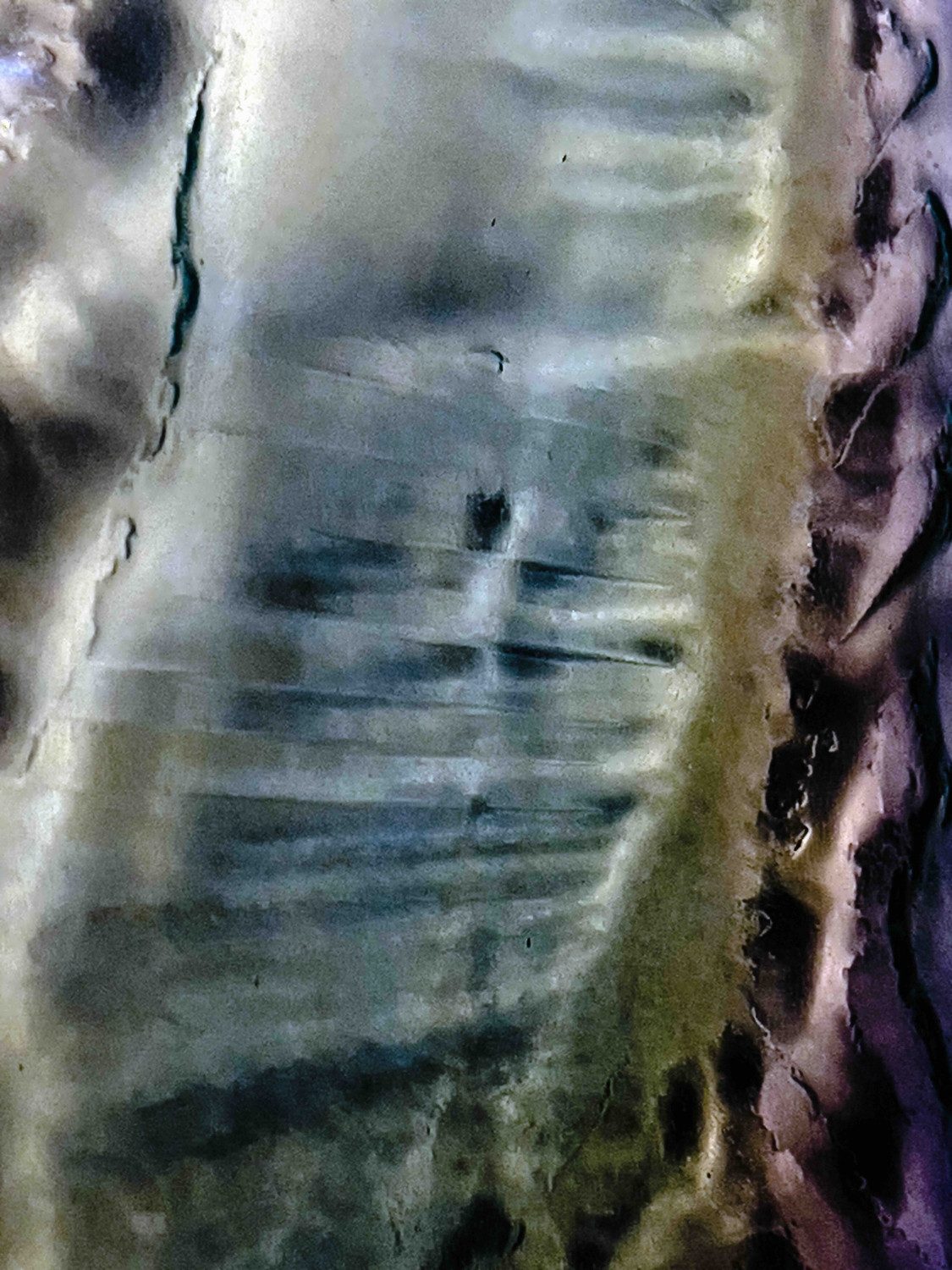
I had previously written a fictional narrative presenting Vicky Uslé’s (Santander, Cantabria, 1981) vitreous and photographic work as an investigation into light, perception, matter, and its transformation. In that text, the figure of a guru functioned as an interpretive mediator who, drawing on philosophical, theological, mythological, and historical references, proposed that the works be understood as processes in which light, the properties of the material, the passage of time, and the artist’s intervention all participate in the generation of forms, traces, reliefs, and unrepeatable configurations. The guru’s eventual transformation into a saline puddle takes this reflection to its ultimate consequences: the subject who had set out to explain the work ends up dissolving into the very process of material transformation he had been describing. Something similar occurs in Resurfacing Iris, Vicky Uslé’s current solo exhibition at alexander levy, insofar as it continues the same body of work. Yet, as I examined the new works, another series of thoughts began to take shape.
Starting with gravity, as evoked by the sculptural presence of these new works, their play of light and shadow, and their colors, I find myself thinking of the theory proposed by João Magueijo and Lee Smolin known as rainbow gravity. According to this theory, the metric of spacetime depends on the energy of the particle probing it: the geometry a photon “sees” varies with its energy. Each color, so to speak, would inhabit a space of its own. What I borrow from this theory is the suspicion that light does not pass through the same thing in the same way, depending on what it is. Glass, meanwhile, does something related without requiring any particularly audacious hypotheses. It is a dispersive medium, with a refractive index that depends on wavelength, such that each color travels through a different effective geometry. This is what we call a prism, and the prism comes with a long history of grievances. Keats lamented that Newton had destroyed the poetry of the rainbow by reducing it to prismatic colors, and used the verb unweave. Goethe devoted part of his theory of color to arguing against Newton. Physicists never accepted Goethe’s theory, although his attention to the perception of color proved influential. Of Goethe, in the context of this exhibition, one sentence matters to us: the one that asserts our right to marvel at the manifestations of color and, if possible, to intuit its secrets. Uslé thus occupies the uncomfortable yet fertile position of someone who does not want the magnifying glass to kill the mystery, while knowing, at the same time, that mystery has a structure. This exhibition attempts to hold both things in view.
She draws on a bed of sand and pumice stone. Pumice, it is worth remembering, is also used to smooth surfaces, which means that resurfacing admits, here, an almost atelier-like reading. The glass is fused over the drawing and, as it cools, preserves it: an engraving the material has already “received” and in which it already “dwells. ” Then the light does what no drawing could. It passes through, projecting onto the wall shadows she compares to a lavis, or wash, but one with body and volume. What was pigment on paper becomes, here, delay, deviation, distribution. Her hand is no longer rigid, and sometimes takes a path the eye cannot follow. What others might call a failure, she calls richness. For an audience accustomed to her paper and painting, these pieces are a physical extension of that work, another corporeality for the same old thing: what is there and yet never quite comes into view. Klee put it differently: art makes visible.
To be more concrete, let us turn to the works themselves. It would not be unreasonable, while we are at it, to give some attention to their titles, since they are essential to understanding them. One of the works, a dense red piece with tightly packed relief, is titled Thoth. In English, the name seems to allude to thought, which is consonant with the role of this Egyptian god of writing and messenger, the counterpart of the Greek Hermes. For Derrida, Thoth is the god who offers writing as pharmakon, remedy and poison at once. Among its various meanings, that same word also encompasses color and painting. A red work called Thoth thus brings together things that refuse to be separated: color, thought, writing, and healing. The piece is writing because it is a drawing in sand fixed by fire. And in the myth, it is Thoth who, more often than anyone else, restores the eye torn from Horus, whose presence in this exhibition takes material form in blue, as an ovoid bulb of relief set among blacks and a remnant of yellow. When the eye was broken, it was all that remained, and hence the name. The myth confirms the connection with an almost uncomfortable precision: the Eye of Horus, broken into pieces and reassembled by Thoth, is called wedjat, “the one that has become whole again. ” Thoth and Horus thus occupy the positions of healer and healed.
Philyra, ochre-yellow and vertical, its furrowed surface reminiscent of a tree bark, takes its name from an Oceanid in Greek mythology and the mother of the most celebrated of the Centaurs, Chiron, born of her union with Cronus. When his wife, Rhea, surprised them together, Cronus fled in the form of a horse, and Philyra was transformed into a linden tree (philyra is the Greek word for linden). At this point, it becomes clear that the exhibition will proceed through an ongoing game of mythological ping-pong, back and forth between Greece and Egypt.
Neith offers another example, this time from the Egyptian side. Plato identifies her with Athena. Plutarch recounts that in Sais, the statue of the goddess, whom he calls Isis, bore the inscription that she was all that had been, is, and will be, and that no mortal had ever lifted her veil. Proclus, who attributes the inscription to Neith, adds that the sun was born from her. She is the veil that cannot be lifted, and Uslés’s sculpture (cream-colored, translucent, its relief resembling a braid or woven fabric) is the palest and most veiled in the series.
Elaia, the largest piece, in a brownish olive, is the gift with which Athena won the city from Poseidon and his spring. According to one version of the myth, the women voted for Athena, and Uslé associates the olive tone with the feminine and with matriarchy. Herodotus recounts that after the Persians burned the olive tree, it sprouted again from the stump: a reemergence, a resurfacing. Neith and Elaia are one and the same goddess in two registers. The figure is veiled; the fruit is offered. Nereus, meanwhile, brings together two shades of green. In Hesiod, Nereus is truthful, the Old Man of the Sea who does not lie, and, like Proteus, he changes shape: Heracles captures him while he is in the midst of transforming. His truth encompasses both prophecy and justice. Two greens joined together make a body in two states.
Ma’at is reddish orange and the broadest of the works. Orange is a color Uslé had rarely used before, and one she associates with working through trauma and releasing a memory that will not allow one to move forward. Ma’at embodies truth as measure: her feather counterbalances the heart in the judgment of the dead. We have, then, three truths. Nereus does not lie, Ma’at weighs, and Neith refuses to be unveiled.
To bring this back to the title of the project, the work Íris, in a dark violet approaching indigo, represents the opposite extreme from the red of Thoth. It was the only word Uslé had to work with before any of the other titles existed. For Hesiod, Iris is the daughter of Thaumas, whose name means wonder, and Plato drew on this genealogy to argue that wonder is the sole beginning of philosophy. In Ovid, Juno sends Iris to the House of Sleep. As she enters its darkness, the radiance of her mantle illuminates the cavern, a silent place save for a stream, and she departs again along the arc of her rainbow. The darkest work in the series bears the name of the messenger of light. To me, it represents the place where the rainbow descends into sleep. And the iris of the eye, which Uslé wants to have present in the work, is the part that regulates how much light enters.
As for the photographs, they consist of what remains of the drawing once the drawing disappears. Uslé takes them before the glass touches the sand, when the repeated stroke appears “as though engraved in stone, ” in pale yellow; while the light passes through the glass and leaves its trace on the gesture; or afterward, once the glass has hardened. In one of the photographs, the result resembles her pastel work, her drawing on paper. Derrida would call this a trace: that which, in disappearing, retroactively constitutes what it leaves behind. The drawing on the sand exists only as a trace, in the glass and in the photograph. Its original, undone in the kiln, was never entirely there to begin with.
Which leaves the question Uslé asks herself in front of the kiln: what is there in the ash? There is a familiar image of human ashes, seen under a microscope, resembling a galaxy.
The remains of cremation consist primarily of calcium phosphates, ranging in color from white to gray. The color in which bone shines under polarized light is associated with the arrangement of collagen fibers, while cremation eliminates water and almost all soft tissue. There is no rainbow in the ash. What there is, instead, is a genealogy. Much of the calcium in the universe is thought to have originated in supernovae. Phosphorus forms in massive stars. And the silicon found in the silica of glass and sand is forged in massive stars and dispersed when they explode; the Spitzer Space Telescope detected silicate dust in the remains of the supernova Cassiopeia A. The atoms in the sand Uslé draws on and in the bone that burns thus originate in stellar explosions. Glass and ash are relatives: both are stellar matter.
Color, then, resides in the encounter. Under a polarized-light microscope, interference colors depend on the degree to which each wave is delayed as it passes through a birefringent object. Once again, each color traverses its own geometry. This is the principle the exhibition places on a wall. If matter is understood as light that has spent itself, and shadow as a property of the light that produced it, then the works on view are spent light, and their shadows are light coming back into its own. The rainbow in the ash does not reside in the ash itself, but in the encounter between matter, forged in the interiors of stars, and the light that, passing through it once more, unfolds into color.
Text by Tiago de Abreu Pinto