Julius von Bismarck
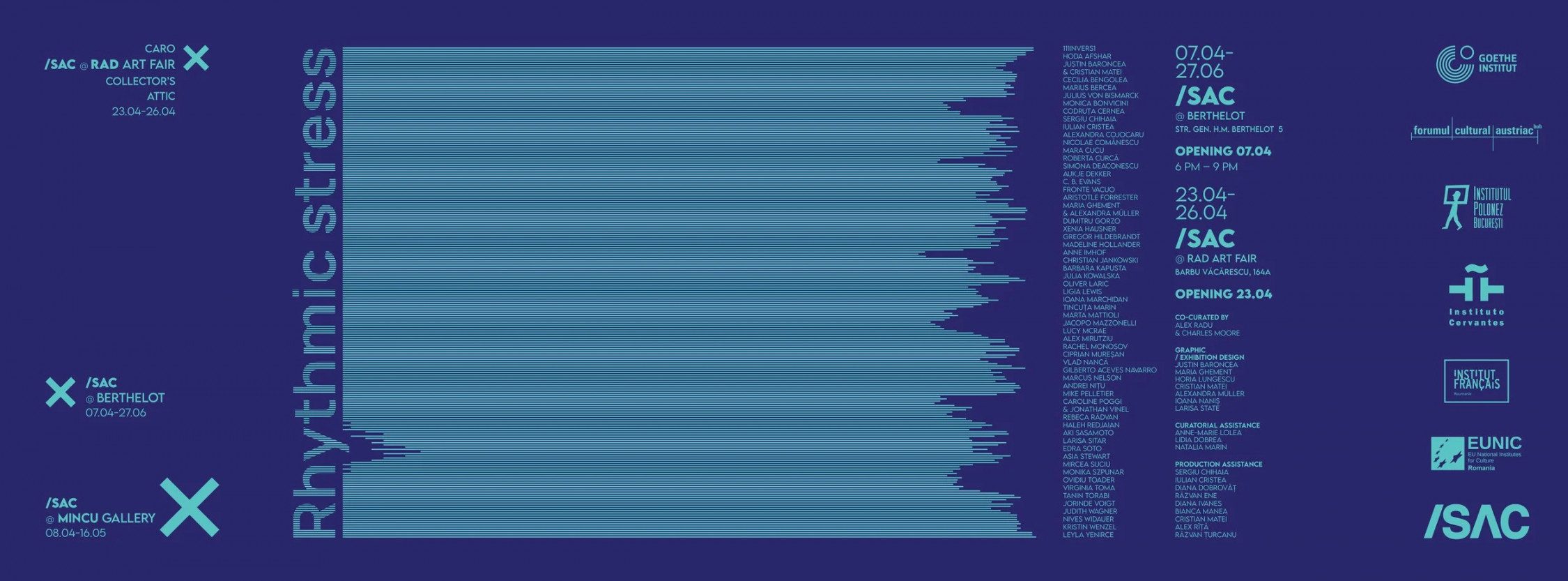
Rhythmic Stress
/SAC, Spatiul de Arta Contemporana, Bucharest, Romania
Apr 7 – Jun 26
Artists: 111invers1, Hoda Afshar, Justin Baroncea & Cristian Matei, Cecilia Bengolea, Marius Bercea, Julius von Bismarck, Monica Bonvicini, Codruța Cernea, Sergiu Chihaia, Iulian Cristea, Alexandra Cojocaru, Nicolae Comănescu, Mara Cucu, Roberta Curcă, Simona Deaconescu, Aukje Dekker, C. B. Evans, Fronte Vacuo, Aristotle Forrester, Maria Ghement & Alexandra Müller, Dumitru Gorzo, Xenia Hausner, Gregor Hildebrandt, Madeline Hollander, Anne Imhof, Christian Jankowski, Barbara Kapusta, Julia Kowalska, Oliver Laric, Ligia Lewis, Ioana Marchidan, Tincuța Marin, Marta Mattioli, Jacopo Mazzonelli, Lucy McRae, Alex Mirutziu, Rachel Monosov, Ciprian Mureșan, Vlad Nancă, Gilberto Aceves Navarro, Marcus Nelson, Andrei Nițu, Mike Pelletier, Caroline Poggi & Jonathan Vinel, Rebeca Rădvan, Haleh Redjaian, Aki Sasamoto, Larisa Sitar, Edra Soto, Asia Stewart, Mircea Suciu, Monika Szpunar, Ovidiu Toader, Virginia Toma, Tanin Torabi, Jorinde Voigt, Judith Wagner, Nives Widauer, Kristin Wenzel, Leyla Yenirce
“Rhythmic Stress” is an inquiry into movement, the movement of bodies, of breath, of images, of language, of architecture, of power. It is an exhibition conceived at the intersection of dance, performance, contemporary art, and spatial practice, where rhythm becomes both a material condition and a political force. Approaching movement not as ornament or spectacle, the conversation instigated by these works becomes a primary strategy for negotiating tension: tension between stillness and eruption, control and release, endurance and collapse, private sensation and public consequence. In this sense, “Rhythmic Stress” positions movement as a response to violence, loss, systemic injustice, and the accumulation of micro-events that shape our bodies long before they become legible as history.
At its core, the exhibition asks how rhythm, understood as a temporal, corporeal, and social structure, operates under pressure. How does stress manifest in the body? How is it rehearsed, absorbed, resisted, or transformed through gesture, repetition, breath, and spatial navigation? And how might dance, choreography, and performative practices offer models for survival, protest, acceptance, or collective recalibration within societies permeated by inequality and rupture?
“Rhythmic Stress” considers movement as a way of thinking and as a way of being. It frames dance, performance, and embodied action as both deeply personal and irreducibly political gestures. These are modes of resistance and repair that operate across scales, from the intimate to the structural. Rage, grief, and exhaustion coexist here with release, liberation, and forgiveness. The exhibition rather creates a field in which contradictory states are allowed to cohabitate, collide, and reconfigure rather than demand resolution.
The exhibition is situated within a broader curatorial commitment to examining what brings us together, what separates us, and how relationships between bodies, communities, and systems are continuously built, negotiated, and contested. Within this framework, “Rhythmic Stress” foregrounds the shared concerns of architecture, contemporary art, and performance. The artists accentuate the ideas of rhythm and counter-rhythm, spatialization and flow, duration and interruption, the choreography of attention, and the politics of presence. The exhibition space itself acts as an active participant. It is an architecture that breathes, resists, compresses, and releases alongside the works it hosts.